 Twolight
How to stop arguing with your partner over small things
You cannot remove every disagreement, but you can change how arguments start, how long they run and how they end. Raise one issue at a time, begin with a feeling and a request, pause when either of you is overwhelmed, and finish with a repair. Here is the routine, step by step.
Coming soon to iPhone
What is the fastest way to stop an argument that is heating up?
Pause it out loud and attach a return time. Something like: I want to keep talking and I am too wound up to do it well. Can we pick this up at eight? A pause with a time is a different act from storming out or going silent, because your partner knows you are coming back.
Researchers who study conflict describe flooding, the moment strong emotion overwhelms one person and thinking narrows. Relationship researchers suggest taking at least 20 minutes, but no more than 24 hours, and spending that time on something soothing instead of rehearsing your case.
- Say you are pausing and name the time you will return.
- Go to separate rooms or take a walk.
- Do something calming: water, music, slow breathing. Do not draft your closing argument.
- Come back at the time you named, even if the feeling is only mostly gone.
- Start with one thing you agree on, then return to the issue.
Why do small things turn into big arguments?
The dish, the late text or the unanswered question is rarely the real topic. Behind it usually sits a need: to be noticed, to rest, to be trusted with a decision. When the need goes unspoken, the small thing carries all of it and gets argued with more heat than it deserves.
Timing adds fuel. Many couples notice that fights cluster in the hungry, tired, rushed hours before dinner or after a long week. If you can name your own pattern, you can schedule hard topics for a different hour.
- The argument is about tone, not the task itself.
- Old examples start arriving: and last month you also...
- Always and never show up in the sentences.
- One of you stops answering and the other repeats the question louder.
How do I raise a small complaint without starting a fight?
Use a soft start-up: a feeling, the situation and a request, in one or two sentences. Summaries of couples research describe harsh start-ups as beginning an argument with great aggression or at an inappropriate time. A soft start-up is the opposite, and it gives your partner something to say yes to.
The same shape appears in Nonviolent Communication, which describes four parts: observation, feeling, need and request. You do not need the full method. Keep the feeling, the moment and the ask.
| Harsh start | Soft start |
|---|---|
| You never help with anything. | I feel overwhelmed when dishes pile up after dinner. Could we split them tonight? |
| Why are you always on your phone? | I miss you when we sit together and both scroll. Can we put phones away for 15 minutes? |
| You are late again. | I get anxious when I do not know where you are. Could you text me if you will be later than seven? |
| That is not what I said! | I think I explained that badly. Let me try again. |
How do we keep an argument to one topic?
Pick the one issue that started it and write the others down for later. A shared note called Parking Lot works: anything that comes up mid-argument goes there, and you agree to look at it on a calmer day. Arguments grow when each complaint triggers a counter-complaint.
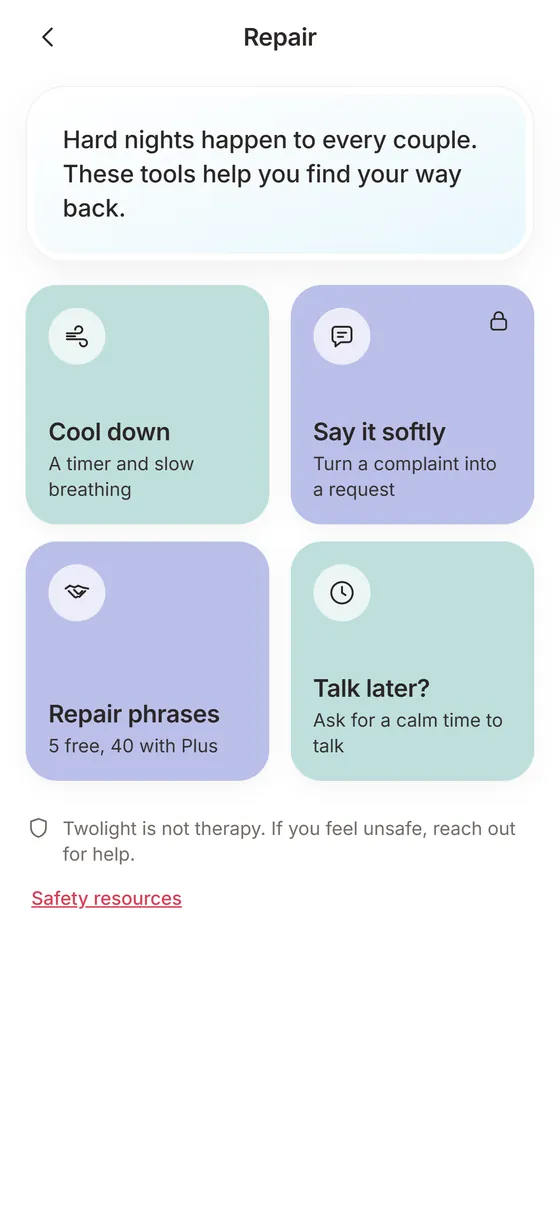
If the topic is too big for tonight, you can ask for a better time. In Twolight, Talk later? sends your partner a calm message such as Alex wants to talk about earlier, calmly. When is good? They can answer Tonight, Tomorrow or Give me time, so nobody has to have the conversation at the worst moment.
- Say the topic in one sentence before you start.
- Before you reply, repeat back what you heard in one sentence.
- Stop after 20 or 30 minutes if there is no progress and schedule a second round.
- Leave out the past unless it is the topic.
What helps right after an argument ends?
Repair. Even a good argument leaves a mark, and a small act of kindness within a few minutes keeps it from setting. Offer your part of the apology, not a full verdict (see how to apologize after a fight), then do something ordinary together: tea, a short walk, a few minutes on the couch.
Short phrases make this easier when words are scarce. The free repair phrases in Twolight include Can we start over?, I am on your side, even right now., and You are more important to me than being right. Say them in your own voice, and only if you mean them.
How can we have fewer arguments in the first place?
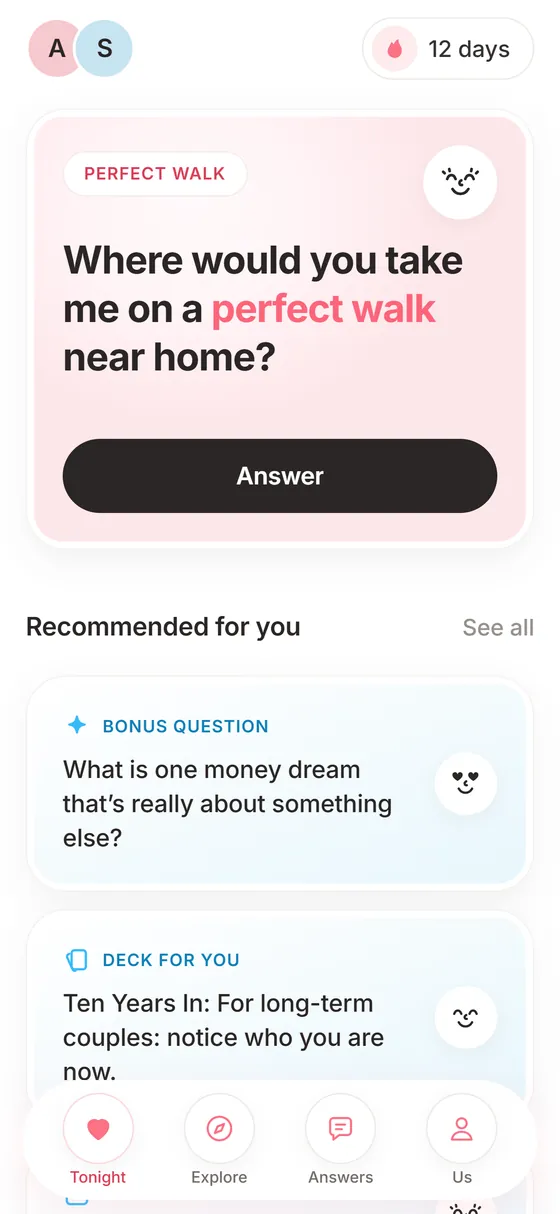
Spend small amounts of time on connection when nothing is wrong. A five-minute daily question gives you a regular way to talk about something other than logistics, and a weekly check-in (see relationship check-in questions) catches irritations while they are still small.
It also helps to pay attention to what goes well. Saying thank you out loud for the dishes, the call or the coffee builds a stock of goodwill, which makes the hard conversations easier to enter. The Gratitude deck in Twolight has cards for exactly this, such as What did I do this week that made your day easier?
Which small topics start most fights?
The list is surprisingly short and predictable. Couples tend to argue about who does what at home, how to spend free time, how much to spend on small things, screens at the table, and tone of voice. Seeing the pattern helps because you can decide in calm moments what each of these should look like, before the next flare-up.
A short agreement removes a topic from the fight list for months. We load the dishwasher after dinner, and whoever cooks does not clean. Phones go in a basket during meals. We check with each other before booking anything on a weekend. Write the agreement in your own words and revisit it when life changes.
- Household tasks: write down who owns what, including the invisible tasks such as booking appointments.
- Free time: agree on one evening a week that is just for the two of you.
- Small spending: set a number under which neither of you needs to ask.
- Screens: choose a time or place that is screen-free.
- Tone: ask for a restart when the voice gets sharp, with a phrase like Can we start over?
Does arguing over text make things worse?
Usually, yes. Text removes tone, face and pace, so a neutral line reads as cold and a joke reads as an attack. Long chains of messages also let each of you rehearse a reply while the other is typing, which is the opposite of listening.
Use text to set up the conversation, not to have it. If you notice a thread heating up, write one line: This matters to me and I want to talk in person. Can we do that tonight? Then put the phone down. If you are far apart, switch to a call or a voice message, and agree on a time with the help of the dual clock described in long-distance tools.
When is it time to get outside help?
Seek a licensed counselor or therapist if the same fight returns for months despite honest effort, if either of you uses contempt, name-calling or threats, or if you cannot talk without one person shutting down completely. Seeking help is a normal step for couples and says nothing bad about the relationship.
If you ever feel unsafe at home, contact local emergency services or a trusted person. Twolight is a communication aid and not therapy, and it includes a Safety resources screen in Settings for this reason.
Frequently asked questions
Is it normal to argue with my partner every day?
Disagreements are a normal part of couples life. What matters more is how they start, whether either of you is hurtful, and whether you repair afterward. Daily fights that feel scary or leave you dreading the evening are worth taking seriously.
Why do we argue about the same thing over and over?
A repeated argument often points to an unspoken need or a real difference in habits that has not been discussed directly. Try naming the need behind the topic instead of the topic itself.
How long should a break during an argument last?
Many couples start with 20 to 30 minutes, which matches researchers' guidance of at least 20 minutes and no more than 24 hours. The timer in Twolight offers 10, 20 or 30 minutes.
What if my partner will not stop arguing?
You can only change your side of it. Pause calmly, say when you will return and keep that promise. If one of you cannot stop or the argument turns hurtful, ask for a neutral third person such as a counselor.
Can an app stop us from arguing?
No app can. Twolight offers a cool-down timer, a sentence builder and calm phrases that make a pause and a soft start easier, but both partners have to want to use them.
Keep exploring
 Couples Repair KitCool-down timer, soft start-up, repair phrases and a talk-later message.How to Apologize After a FightA calm, practical way back after an argument.Daily Questions for CouplesA small, regular question habit that survives busy weeks.
 Daily Question for CouplesOne question a night; answers reveal when both are in.