 Twolight
How to apologize to your partner after a fight
To apologize after a fight, take a pause until you can listen, name what you did without adding but, say what you will do differently, and ask what your partner needs. Short, specific phrases work better than a long speech, and timing matters more than wording.
Coming soon to iPhone
When should I apologize?
When you are calm enough to listen. Researchers who study couples in conflict describe physiological flooding, when a racing heart makes it hard to hear anything. Research on couples in conflict is the best-known source, and its usual advice is at least 20 minutes, but no more than 24 hours, apart while flooded. An apology made while still flooded often restarts the fight.
What should I do while I wait?
Do something calming that has nothing to do with the argument. The research quoted above recommends self-soothing, relaxing or distracting activity during the break. Walk, wash dishes, stretch, breathe slowly. Do not rehearse your case or draft a long text, because that keeps your body in the fight even when you are standing still.
What are the steps?
A simple sequence:
An example in words: I raised my voice and cut you off, and I can see it made you feel unheard. Next time I will let you finish. What do you need from me right now? It names the act, the effect, the change and the offer in four short sentences.
- Pause. Say you need time and that you will come back, then do come back.
- Cool down with slow breathing and no rehearsing of arguments.
- Name what you did. A specific sentence, such as I raised my voice and cut you off.
- Say how it landed for them, not how you meant it.
- Offer one concrete change and ask what they need.
Can I apologize without just saying sorry?
Yes, and sorry is fine as long as it is not the whole apology. A full apology has four parts: what you did, how it landed, what you will change and what your partner needs. Sorry alone covers none of them.
Compare I'm sorry you feel that way with I'm sorry I raised my voice. The first apologizes for the other person's reaction. The second owns your act.
What do weak and better apologies sound like?
The difference is usually one clause. Notice who the sentence is about.
| Weak | Better |
|---|---|
| Sorry you feel that way. | I'm sorry I raised my voice. |
| I said sorry already. | I know I hurt you. What would help right now? |
| I was just tired. | I was tired, and that is my job to manage. Next time I will say so. |
| Sorry, but you also... | I'm sorry. I would like to talk about my part first. |
What should I avoid?
Things that turn an apology into a new argument:
The common thread is that an apology is about the other person's experience. If it turns into a defense of your intentions, it has stopped being an apology.
- But. Anything after it cancels what came before.
- If you felt hurt. It puts the doubt on their feelings.
- A long speech, which makes your partner the audience.
- Demanding an apology in return.
- Apologizing by text for something that needs a face and a voice.
What short phrases help?
Short lines are easy to say when your throat is tight. Examples from Twolight's repair kit: Can we start over? I'm on your side, even right now. I need a few minutes, and then I want to come back to this. I think I got defensive. I'm sorry. What do you need from me right now?
Choose one that is true for you and say it plainly. A borrowed line that you do not mean is easy to hear as hollow.
What should I promise?
Promise only what you will do. I will never raise my voice again sounds good and is almost certainly untrue, which means your partner learns to discount your promises. I will tell you when I need a break instead of leaving can be kept. Small and specific beats big and vague, and one kept promise does more for trust than five broken ones.
What if I was only partly wrong?
Own your part and only your part. I'm sorry I snapped. I still want to talk about the dishes, but later says two honest things. It does not trade apologies, and it does not pretend you were wrong about everything.
An apology offered to get one back is a negotiation. If you want to talk about your partner's part, wait until the first apology has landed.
What if we both said hurtful things?
Take turns. One of you speaks while the other only listens, then you swap. Start with your own part: I said you never listen, and that was unfair. Use a timer if the speaker tends to run long, and agree that the listener does not defend until their turn. Twolight's repair phrases, such as I want to understand, not to win, give a shaky voice something to hold on to.
How does a soft start-up help?
If you need to bring up your own complaint, a gentle start works better than an accusation. Use three parts: I feel, when, I need. For example: I feel lonely when our evenings disappear into our phones. I need 15 minutes with you after the kids sleep. Twolight's Say it softly builds that sentence from 12 feelings and your own words.
What if my partner does not accept it?
Give it time. Say it once, plainly, and offer to talk when they are ready. Repeating it louder asks them to forgive on your schedule.
The Wikipedia summary of research on couples in conflict describes a repair attempt as anything one partner does to bring the relationship back on track, even a joke you both share, and notes that these attempts help when the other person accepts them. A refused apology can still be a repair attempt. Your partner may need an hour or a night.
How do I know the apology worked?
Look for small signals: your partner's tone softens, they answer with more than a word, or they offer their own part. None of these is guaranteed, and an apology does not put a clock on forgiveness. If the answer is not yet, accept it, keep the promise you made and try again tomorrow.
What do I do the next day?
An apology is judged by what follows. Check these in the next 24 hours:
- Do the one change you promised, however small.
- Check in once, lightly: How are you feeling about last night?
- Thank your partner for listening if they did.
- Do not bring up the fight again as evidence in a later one.
What if talking is too hard right now?
Ask for a time instead. Talk later? sends a calm message such as I want to talk about earlier, calmly. When is good? so the conversation happens at a better hour. If you ever feel unsafe, contact local emergency services or a trusted person. A communication aid is not therapy.
How do I start the conversation by text?
A text can open the door but rarely finishes the job. Keep it short and offer a time: I want to talk about last night, calmly. Is tonight after dinner good? That is the same message Twolight's Talk later? sends. Avoid sending an apology you would not say out loud, and avoid long messages that read like a legal brief.
When is an apology not enough?
When the hurt is a breach of trust, such as lying, or when the same fight keeps returning with the same ending, an apology cannot do all the work. Those are good reasons to talk with a licensed counselor, alone or together. Twolight is a communication aid, not therapy, and it has a Safety resources screen for anyone who feels unsafe.
The repair kit turns these steps into a cool-down timer and ready phrases. For the conversation that follows, read how to listen to your partner without getting defensive.
Frequently asked questions
How long should I wait before apologizing?
Long enough to listen without defending, which for many people is 20 minutes or more. Tell your partner you are taking time and will return.
What do I say if I do not know what I did wrong?
Ask. What do you need from me right now? and Can you help me understand your side? open the conversation without pretending.
Is a text apology okay?
A short text can open the door, for example Can we talk later, calmly? The apology itself usually lands better in person.
Does Twolight replace therapy?
No. It offers calm communication aids and a Safety resources screen. For serious problems, speak with a professional.
How do I apologize without saying sorry?
Name what you did, how it landed and what you will change. For example: I cut you off and I can see it made you feel unheard. I will let you finish next time.
What if I was only partly wrong?
Apologize for your part and leave the rest for later. I'm sorry I snapped is true even when the disagreement is not over.
Keep exploring
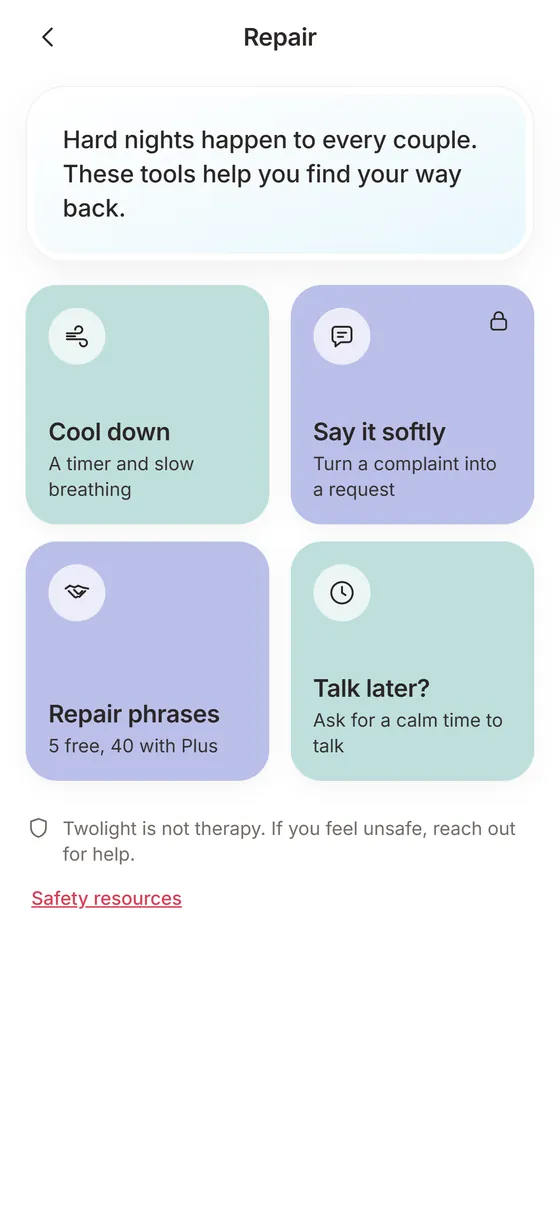 Couples Repair KitCool-down timer, soft start-up, repair phrases and a talk-later message.Questions to Ask Your PartnerSpecific questions sorted by depth, with examples for every stage.
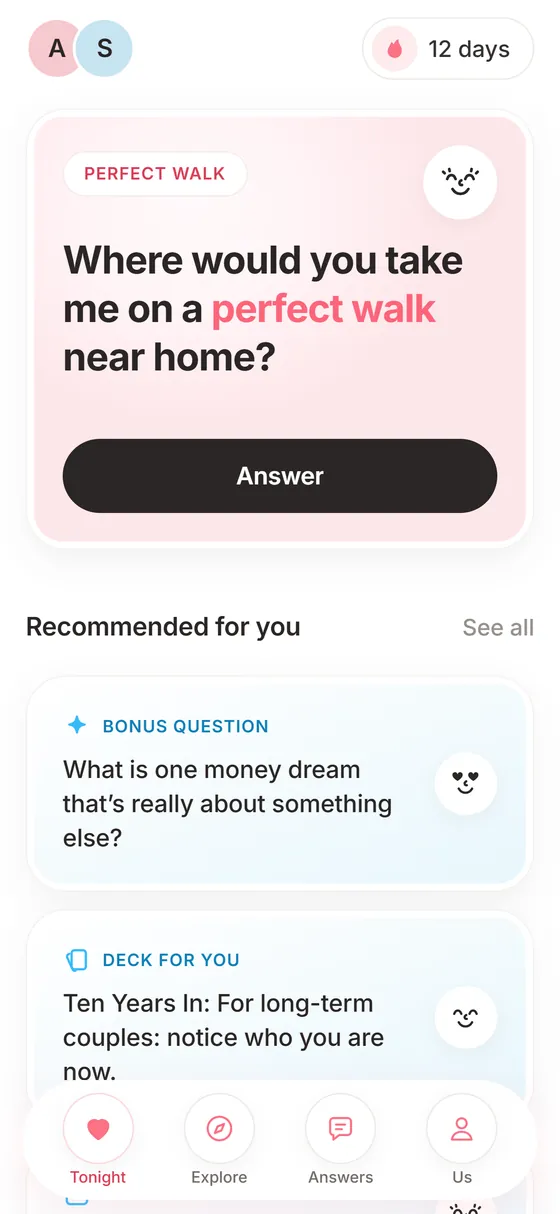 Daily Question for CouplesOne question a night; answers reveal when both are in.How to Listen to Your Partner Without Getting DefensiveFive listening steps, defensive vs open replies, and a five-minute practice.How to Talk About Money With Your Partner Without a FightValues first, then facts, then rules: a calm way to talk money, with scripts.