 Twolight
The five love languages, explained with examples
The five love languages are Gary Chapman's labels for how people give and receive affection: words of affirmation, quality time, gifts, acts of service and physical touch. They work best as conversation starters about what makes you each feel loved, not as fixed personality types. Examples and cautions follow.
Coming soon to iPhone
What are the five love languages?
The framework comes from the 1992 book The Five Love Languages by Baptist pastor Gary Chapman. It proposes five general ways that partners express and experience love. Each person, Chapman suggests, tends to feel most loved through one or two of them.
The names are easy to remember, which explains much of the book's popularity. Their value for couples is mostly practical: they give you words for something people struggle to describe.
| Love language | What it looks like | Small example |
|---|---|---|
| Words of affirmation | Spoken or written appreciation and encouragement | A note saying I am proud of how you handled this week |
| Quality time | Undivided attention and shared activity | A walk with phones off |
| Receiving gifts | Thoughtful tokens that show you were remembered | A favorite snack brought home |
| Acts of service | Helpful actions that lighten the other's load | Handling the errand they dreaded |
| Physical touch | Closeness and affectionate contact | A long hug at the end of the day |
How do I find out my own love language?
Ask yourself three plain questions. What does my partner do that makes me feel most loved? What do I ask for or complain about most often? What would I miss most if it vanished? The answers tend to cluster around one or two of the five.
Online quizzes exist, but a conversation is more useful and free. Twolight's setup asks You feel most cared for through... with five choices: Kind words, Time together, Small surprises, Help with things and A hug. These are the app's own wording, not a test, and they are a quick way to put the topic on the table.
What does the research say?
The evidence is mixed. According to Wikipedia's summary, the concept has been criticized, with some research leaning towards refuting the concept, and a well-known couples psychologist has questioned the usefulness of insisting on showing or receiving love in only one way. A few studies found limited support for some aspects, such as a 2017 study in Personal Relationships involving 67 couples that found limited evidence linking matched love languages with satisfaction.
A fair reading is this: the five categories are a helpful vocabulary, but there is little proof that matching them predicts a happy relationship. Use them to start conversations and not to label each other.
How can couples use the love languages in daily life?
Treat the five as a menu. Offer a little of each, and watch what your partner responds to. Ask directly: Which of these meant the most to you this week? That tells you more than a quiz result.
A simple practice is a weekly swap. Each of you names one small thing the other did that felt like love, and one small thing you would welcome more. Keep requests concrete: a ten-minute walk after dinner, a text during the day, the dishes on Wednesdays.
- Each person chooses one or two ways they feel cared for.
- Share them without defending or debating.
- Each partner picks one small action from the other's list.
- Do it for a week and talk about how it went.
- Repeat with a new action.
What if we speak different love languages?
Mismatches are common and not a sign of a bad match. A partner who shows love through acts of service may feel puzzled when words are what the other wants. Wikipedia's article describes this scenario: a man does the laundry as an act of love, but his wife, who values words of affirmation, reads it as simply a chore.
The fix is translation. Tell each other what you mean by your actions: I did the laundry because I wanted you to have a lighter evening. And ask for what lands for you: it would mean a lot to hear that you are glad I'm here. Neither side has to give up their own way of showing love.
How can I practice each language in five minutes?
Pick whichever fits the day. These ideas take under five minutes, and none of them needs planning:
- Words: send a text that names a specific thing you admire.
- Quality time: sit with your partner and ask What was the best part of your day? with the phone in another room.
- Gifts: pick up one small thing that shows you remembered, such as their favorite tea.
- Acts of service: fill the water bottle, charge the phone, or warm the car.
- Touch: a hug that lasts six seconds, or a hand on the back while they cook.
Can you use games and decks to learn each other's language?
Yes. A deck question like When do you feel most appreciated by me? or What kind of support from me means the most to you? asks the same thing as a quiz but gives you a story instead of a score. Both come from the Gratitude deck in Twolight.
Guess Me can surface it as well. One topic asks How does your partner usually show care? with the options with words, with actions, with little gifts and with hugs. You guess for your partner, they answer for themselves, and the reveal shows you what you knew. Read more in Guess Me.
Why do people like the love languages?
Because they turn a vague wish into a sentence. Saying I need more quality time is easier to hear than you never pay attention to me. The labels also reassure people that their partner's different habits are not rejection but a different dialect of affection.
That reassurance is worth keeping, even if the science is thin. Used lightly, the model opens a conversation that many couples do not have: what, exactly, makes each of you feel cared for? A few minutes spent on that question can change what you do next week.
How do I raise the topic without it feeling like homework?
Make it a game of small guesses. Ask your partner to guess what you would most like on a rough day, then switch. Compare the guesses with the real answers and laugh at the misses. The point is learning, not scoring.
A daily question can do the same job more gently. Over a few weeks, answers such as the best moment of the week, a kind message you remember or a small act that helped will tell you more about your partner than any quiz. Read more in the daily question guide.
What are the limits of the love languages model?
The framework is simple, and relationships are not. People change, feel different needs under stress and often value several expressions. A model that boxes you into one category can become an excuse: that is not my language. Use it as a door into the real conversation and not as a rule.
If you find that conflict, not affection, is the main trouble, tools for calm communication may help more than guessing a love language. See how to stop arguing with your partner and the repair kit.
Frequently asked questions
What are the 5 love languages?
Words of affirmation, quality time, receiving gifts, acts of service and physical touch, as described by Gary Chapman in his 1992 book.
Are love languages scientifically proven?
Not convincingly. Research has found limited and mixed support, and some researchers question the idea of a single primary love language. They remain a popular vocabulary for talking about affection.
Can you have more than one love language?
Yes. Many people value several expressions, and the balance can shift with stress and life stage. Ask your partner what matters most this month.
How do I know my partner's love language?
Watch what they do for you, what they ask for and what they complain about, then ask them directly. A conversation beats a quiz.
Does Twolight have a love language quiz?
No. Setup asks how you feel most cared for, with five choices, and Guess Me has a topic about showing care. Neither produces a score or a label.
Keep exploring
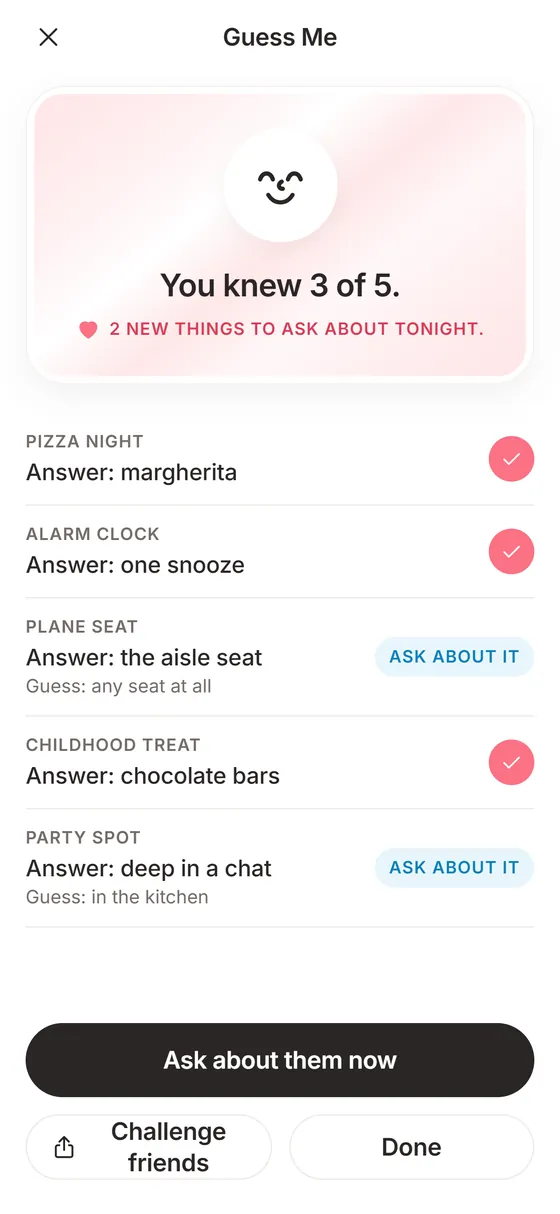 Guess MePredict five answers about your partner; the reveal shows what you knew.
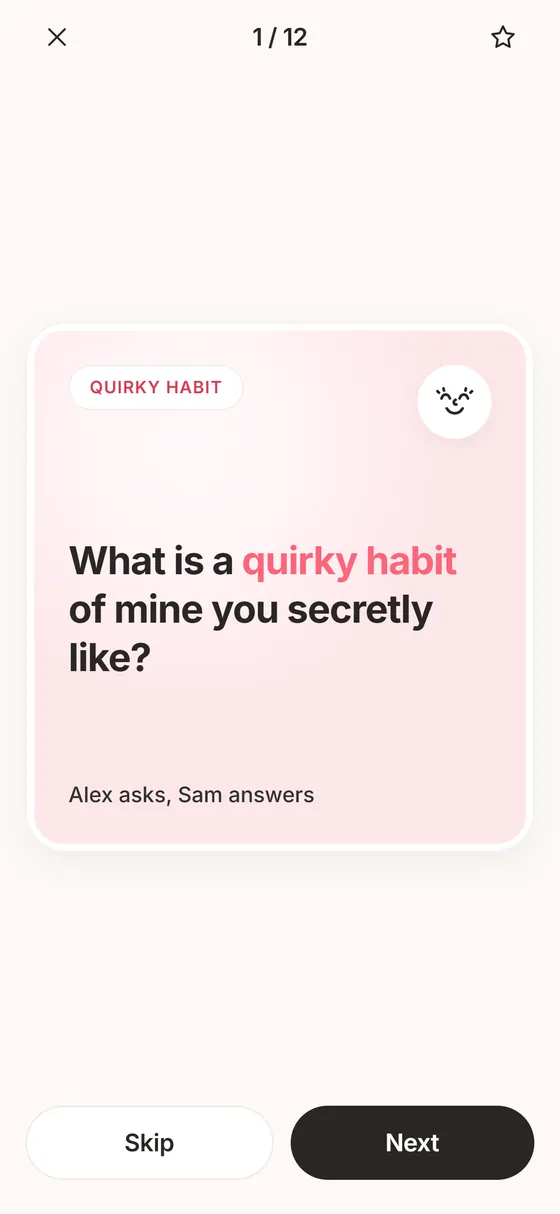 Couple Question Decks and Couch Mode on One PhonePass one phone back and forth with 14 decks of questions.Questions to Ask Your PartnerSpecific questions sorted by depth, with examples for every stage.