 Twolight
Questions to ask your partner, sorted by how deep you want to go
The best questions to ask your partner are specific, easy to answer in a sentence or a story, and matched to how much depth you both want tonight. Start light, move to warm, and keep deep questions for when you are rested. Examples for each stage follow.
Coming soon to iPhone
What makes a good question for a partner?
People look for this topic with variations like to get to know them better, for fun, before marriage and before moving in. All of them point at the same need: a question that opens a story. Specific beats big. What is a quirky habit of mine you secretly like? gets a laugh and a story. What do you want from life? gets a pause.
Psychologist Arthur Aron studied closeness with a set of 36 questions that grow gradually more personal. The takeaway for everyday use is the gradient: start easy, go a little deeper each time.
Should we use the 36 questions?
They are a good tool for one specific job. According to Wikipedia, Arthur Aron and colleagues published the set in a 1997 paper, The Experimental Generation of Interpersonal Closeness. Pairs of strangers asked each other questions of increasing intimacy and developed a stronger friendship afterward. A 2015 New York Times essay by Mandy Len Catron, To Fall In Love With Anyone, Do This, made the list famous.
The lab used strangers, so treat the list as a conversation tool and not a love formula. It works best for a first long talk or a rare quiet evening. For everyday use, take the gradient: light, then warm, then deep, a little at a time.
What are light questions?
Light questions (depth 1) take a minute and are safe on a tired Tuesday:
Light does not mean empty. A question about a song or a coffee ritual still tells you what the other person notices and values, and it keeps the habit easy enough to repeat.
- What tiny moment with me felt meaningful lately?
- Which song reminds you of us, and why that one?
- Which fictional couple are we most like?
- What is the best part of your morning coffee or tea ritual?
- Which of our old jokes still makes you laugh?
What are funny questions to ask my partner?
Silly questions lower the stakes and are often better openers than serious ones. These come from the Play deck:
- Which fictional couple are we most like?
- If we hosted a cooking show, what would it be called?
- Should we adopt a pet dragon or a talking cat?
- What would our superhero names be?
- Which movie world should we live in for a week?
What are warm questions?
Warm questions (depth 2) ask for a feeling or a memory:
Warm questions pay off when you follow up. After the answer, ask what a good version of that looks like this week, and then try one small thing.
- When do you feel most at ease around me?
- How do you most like to be looked after when you are tired?
- What helps you feel close to me when we are both busy?
- What is a small moment from this week you want to remember?
- What kind of support from me means the most to you?
What are deep questions?
Deep questions (depth 3) are for a rested evening with time:
Deep questions go better with a plan. Say that you have one for later, choose an evening when neither of you is hungry or rushed, and agree that either of you can pause. Twolight keeps deep cards mostly in decks such as Hard Things and Repair Conversations, so they do not turn up by accident.
- When do you feel least heard by me?
- What do you worry about most as a parent?
- What helps you forgive when something still hurts?
- If we could relive one day together exactly, which would you pick?
What questions work after many years together?
Long-term couples often assume they already know the answers. People change, though, and questions that surprise you are the best kind. From the Ten Years In deck:
- What about you has become different since we met?
- What part of our daily routine would you change for more closeness?
- How could I surprise you after all this time?
- What conversation have we been putting off that could bring us closer?
Which questions fit which stage?
A rough guide, using the decks in Twolight:
| Stage | Try | Sample |
|---|---|---|
| First year | New Love | What was your first impression of me? |
| Living together | Tiny Moments | What street or corner near us do you secretly love? |
| Parents | Parents Tonight | What task could I take off your plate this week? |
| Long distance | Far Apart | What would we do in the first hour of our next visit? |
| Ten years or more | Ten Years In | What keeps our relationship feeling fresh for you? |
What should we ask before moving in together?
These are conversation starters, not a checklist, and they are not from the Twolight decks. Ask them over a meal, not mid-argument:
- How do we split chores, and what counts as done?
- How do we feel about guests and quiet hours?
- What stays separate, and what do we share, when it comes to money?
- What do you need in a home to feel relaxed?
- How do we handle a bad day when one of us needs space?
What should we ask before having kids?
This conversation matters more as a series than as one marathon. Nothing here predicts anything. It just makes later talks easier:
- What do you want an ordinary Tuesday to look like with a child?
- How do we want to split the nights?
- What did your parents do that you want to repeat, and what do you want to change?
- How do we want to handle work, money and help from family?
- What would you need from me on the most exhausted day?
How do I ask without it feeling like an interview?
Answer first. Say your own answer, then ask theirs. Put the phone down. Take turns. Do not correct each other's answers. If a question lands badly, move on and come back another night. Twolight builds this into couch mode, where the card says who asks and who answers, and nothing you say is saved.
What if my partner gives one-word answers?
Ask for a small story instead of an opinion. Tell me about the last time that happened is easier than How do you feel about it. Offer two or three choices, answer first yourself and leave a few seconds of silence. Some people think while they talk and others think before they talk, and a quiet partner may be doing the second.
How do I ask a hard question without starting a fight?
Choose the moment, announce the topic and give a way out. Something like I have a harder question for later. Is Sunday afternoon good? tells your partner what is coming and when. Agree on a pause word, such as break, so either of you can stop without it meaning anything. Begin with your own answer to the question to show that it is safe to be honest.
Which questions should wait for a better moment?
Skip serious questions when either of you is hungry, tired, rushed or in the middle of an argument. Avoid them in public, with other people listening, and when alcohol is involved. A good rule is that a question you would not want to answer in the car park should wait for the kitchen table. Saying later, and meaning it, respects the question.
What do I do with the answer?
The answer is the start of the conversation, not the end. A simple routine keeps it kind:
You can take them one at a time with the daily question, or pass a phone back and forth with the question decks. The daily questions routine shows how to keep it going.
- Let your partner finish before you speak.
- Repeat back one detail, such as So the corner bakery mattered to you.
- Ask one follow-up. Tell me more about that works almost every time.
- Share your own answer.
- Say thank you, even if the answer surprised you.
Frequently asked questions
What are good questions to ask your partner to get to know them better?
Specific, story-opening ones such as What tiny moment with me felt meaningful lately? or What is your favorite way for me to say thank you? Start light and go deeper over several evenings.
How many questions should we ask in one evening?
One is enough. Twolight's ritual is one question, a couple of minutes each, so it stays a habit and not a project.
What if my partner does not like questions?
Try a game first. Guess Me or a silly Play question lowers the stakes, and a date idea gives the conversation something to do with its hands.
Are there questions I should avoid?
Skip anything that works as a trap, such as questions that start with why do you always. Frame it as curiosity about their experience.
Are the 36 questions worth using?
They suit a long first conversation. The research used strangers in a lab, so treat them as a way to build closeness gradually and not as a shortcut to love.
What should we ask before moving in together?
Chores, money, guests, quiet hours and how each of you handles a bad day. Ask over a meal, and expect more than one conversation.
Keep exploring
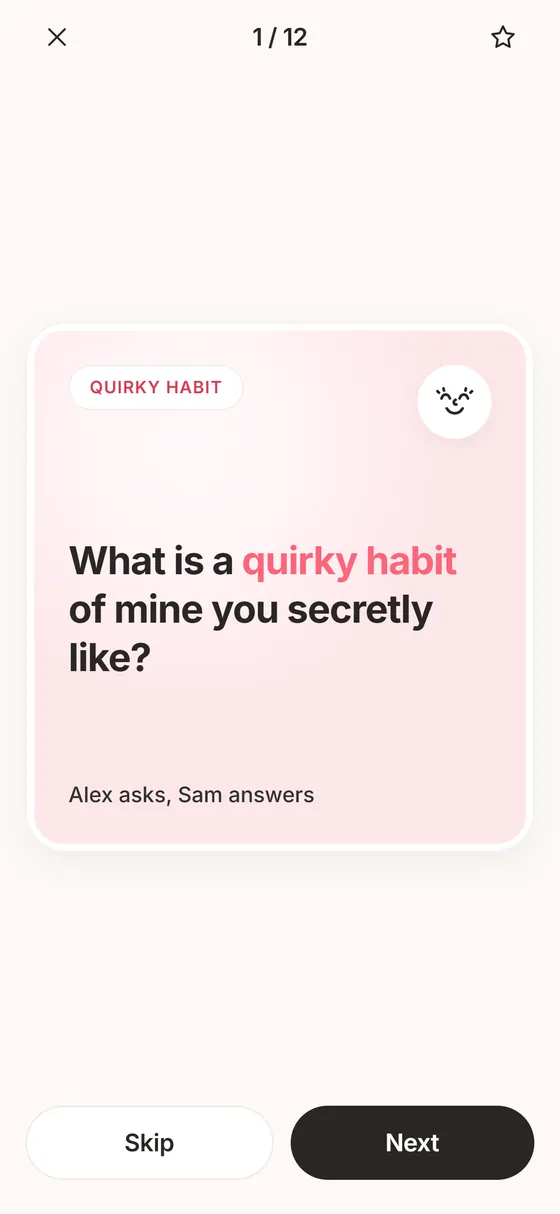 Couple Question Decks and Couch Mode on One PhonePass one phone back and forth with 14 decks of questions.
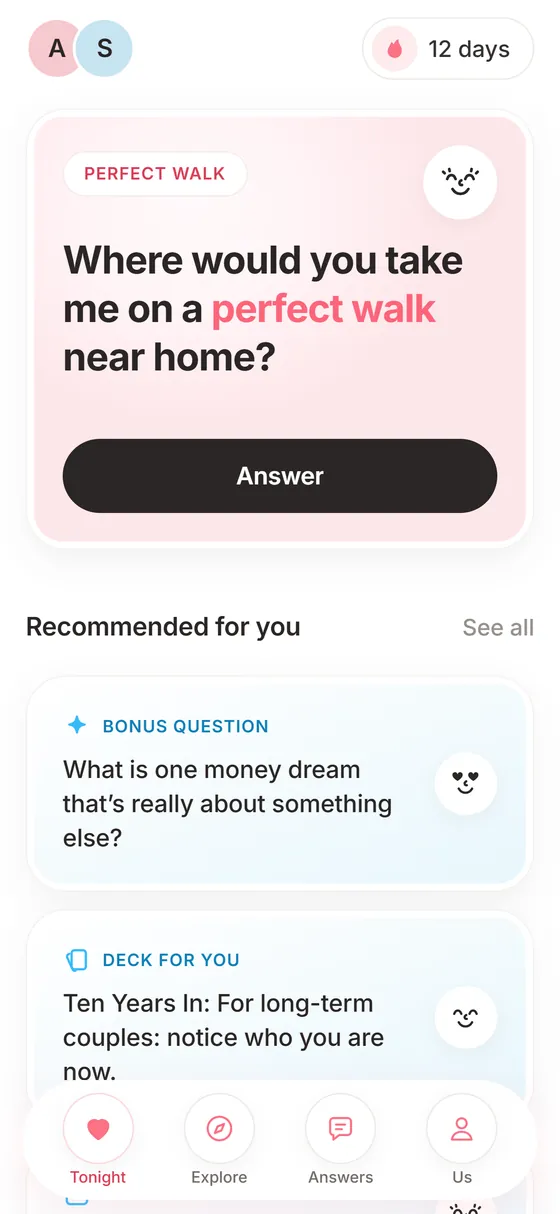 Daily Question for CouplesOne question a night; answers reveal when both are in.
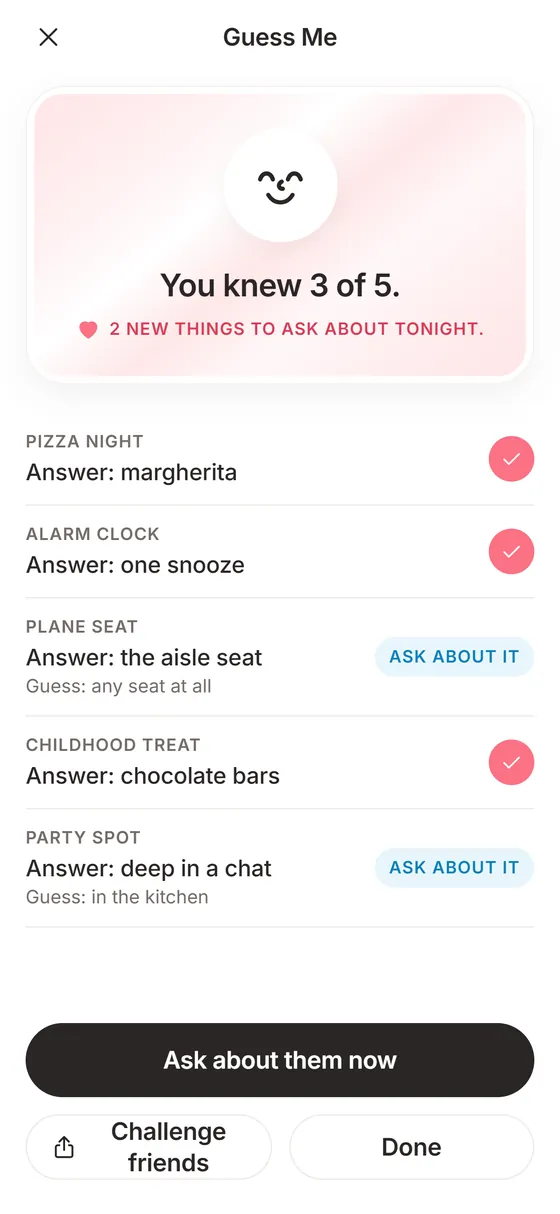 Guess MePredict five answers about your partner; the reveal shows what you knew.