 Twolight
How to start a hard conversation with your partner
Start a hard conversation by choosing a calm moment, giving a short heads-up, and opening with what you want for the two of you before you describe the problem. One topic, one feeling, one request. Then ask what your partner thinks and agree how to pause if it gets heavy.
Coming soon to iPhone
When is the right time to bring up a difficult topic?
Pick a time when neither of you is hungry, rushed or in the middle of something else. Late at night, right after work, and during an argument about something else are the worst slots. A walk, a quiet weekend morning or a calm evening after dinner works for most couples.
Avoid bringing it up in public or by text unless the text is only a request for time. A message like Can we talk about our weekend plans tonight? is fine. The topic itself belongs in a conversation where you can hear each other's voices.
- Good: a walk, a drive, a quiet weekend morning, after dinner with the phones away.
- Poor: during another fight, right after a tiring day, in front of other people, in bed when one of you is falling asleep.
Should I warn my partner first?
Yes, briefly. A heads-up lets your partner prepare instead of being ambushed, and ambushes trigger defensiveness. Keep the message short and calm, and say the topic and the tone: I would like to talk about money this weekend. Nothing is wrong between us, I just want a plan we both like.
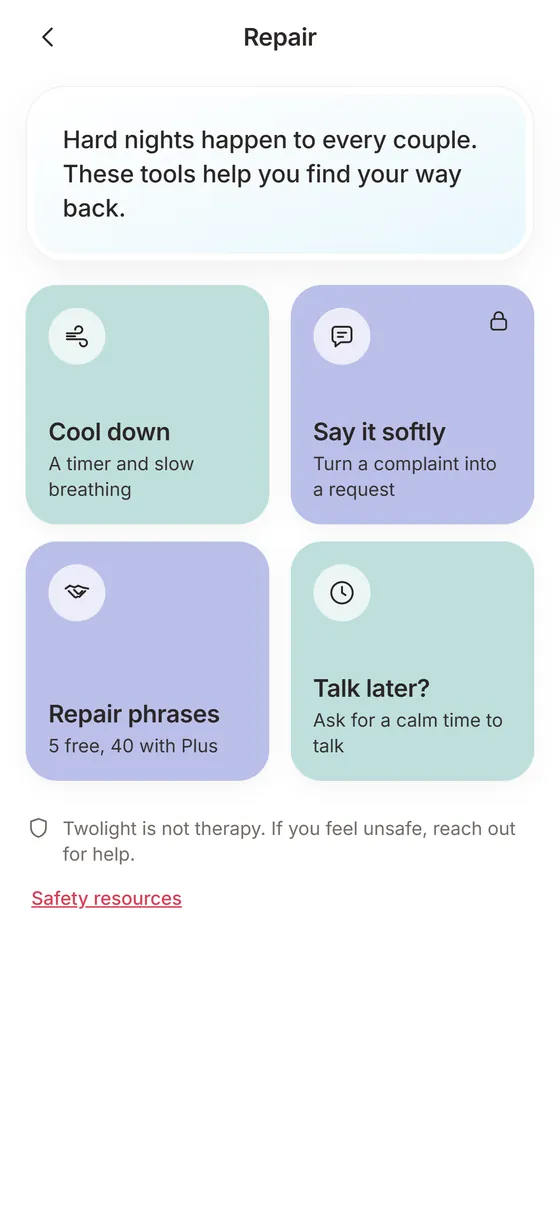
In Twolight, the Talk later? tool sends a ready-made version: Alex wants to talk about earlier, calmly. When is good? Your partner picks Tonight, Tomorrow or Give me time, and the reply tells you which. The point is that nobody is surprised.
What is a good opening line?
Start with the shared goal, then the topic, then your feeling. Compare: You spend too much to I want us to feel relaxed about money, and I feel tense about last month. Can we look at it together? The second line names a goal both of you can accept.
A simple structure from research on conflict is the soft start-up, described in a Wikipedia summary. Say how you feel, in which situation, and what you would like. Twolight's Say it softly builds this sentence for you from 12 feelings: I feel lonely when our evenings disappear into our phones. I need 15 minutes with you after the kids sleep.
- State the goal: I want us to feel good about...
- Name the topic in one sentence.
- Say one feeling and one concrete request.
- Ask: How does that sound to you? What would you change?
What do I say first for common topics?
These openings are starting points. Use your own words, and keep the request small:
| Topic | Opening line |
|---|---|
| Money | I want us both to feel safe about money. Could we look at the month together on Sunday? |
| Chores | I feel stretched in the evenings. Can we agree on who does what this week? |
| Time with friends | I love that you see your friends. I would like us to plan a couple of evenings a week for just us. |
| In-laws or family | I want holidays to feel good for both of us. How should we decide where to go? |
| Moving or a big decision | I would like to think about this together and not rush. What matters most to you? |
How do I listen once the conversation starts?
Let your partner finish, then say back what you heard in one sentence before you reply. Active listening is the name for this habit of confirming that the point came across. If your partner feels heard, they will stop repeating the point louder.
Ask questions that open the topic. Tell me more about that. What would make that easier for you? What does a good version of this look like? Twolight's Talk about it prompts use the same style, such as What is one small thing we could try this week?
How do we agree on a pause?
Agree on a pause before you need one. Choose a word or a sentence that either of you can say without it counting as a loss: Can we take 20 minutes? I want to come back to this. The Repair Conversations deck in Twolight includes a card on exactly this, What could be our pause signal when a talk gets heated?
When a pause starts, say when you will return. The cool-down timer runs 10, 20 or 30 minutes, with a breathing guide and a Let your partner know button that sends a short message. After it ends, you can use Say it softly to restart.
How should the conversation end?
End with something small and specific: one next step, a time to check back, or a thank you. We decided to look at the budget on Sunday at ten works better than We should probably do something about this. If you did not finish, say so and set the next time.
Close on warmth. Thank your partner for talking, even if the talk was clumsy. A hug, a cup of tea or a show on the sofa tells both of you that the relationship is bigger than the topic.
What if my partner reacts badly anyway?
Even a perfect opening can land badly. Your partner may be tired, stressed or reminded of an older hurt. Do not take the first reaction as the final answer. Stay calm, say that you can see this is hard, and offer to pause. You are not trying to win the first minute, only to keep the door open.
If the reaction is anger, avoid matching it. Lower your voice and shorten your sentences. If the reaction is silence, give a little time and ask one small question, such as What is going through your mind? Either way, a repeat attempt in a day or two, with a softer start, often goes better than pushing on.
How can we get better at hard talks over time?
Practice on easier topics. Couples who regularly talk about small things, such as a worry at work or a plan for the weekend, find the heavy topics less frightening because the habit of talking is already there. A daily question is a cheap way to build that habit.
Twolight's Hard Things deck is written for deeper evenings, with cards like What is a hard conversation we keep putting off? and How can we take a break in an argument so it feels okay for both? Choose it when you are both rested, and stop whenever either of you asks. You can also read about question decks and couch mode for how a round works.
When should a hard conversation involve a professional?
If a topic keeps returning without progress, if either of you feels afraid to raise it, or if the conversation ends in contempt or name-calling, consider a licensed counselor. Some topics, such as health or safety, are better handled with qualified support from the start.
Twolight is not therapy, and it says so. If you feel unsafe, use the Safety resources screen in Settings or call your local emergency number. For everyday topics, a calm opening line and a plan for pausing take you a long way.
Frequently asked questions
How do I start a difficult conversation with my boyfriend or girlfriend?
Ask for a good time, give a one-line heads-up, and open with a shared goal and a feeling instead of a complaint. Then ask what they think.
How do I bring up a problem without causing a fight?
Use a soft start-up: one feeling, one situation, one request. Choose a calm moment and keep to a single topic.
What if my partner shuts down when I raise something?
Slow down, lower your voice and offer a pause with a return time. Many people shut down when they feel overwhelmed. Try again later with a shorter, softer opening.
Is it okay to start a serious talk over text?
Use text to ask for a time, not to have the talk. A line like Can we talk tonight about our plans? is enough.
How long should a hard conversation last?
Often 20 to 40 minutes is enough for a first round. Stop earlier if it stops being useful and schedule a second round instead of pushing through.
Keep exploring
 Couples Repair KitCool-down timer, soft start-up, repair phrases and a talk-later message.How to Apologize After a FightA calm, practical way back after an argument.How to Stop Arguing With Your Partner Over Small ThingsA practical routine for fewer fights: pause, soft start-up, one topic, repair.Questions to Ask Your PartnerSpecific questions sorted by depth, with examples for every stage.