 Twolight
Silent treatment in a relationship: what it means and what to do
The silent treatment means withholding communication from your partner without saying why or when you will return. It differs from a calm break, which has a stated reason and a return time. Below are signs, reasons people go quiet, scripts for both sides, and when to seek support.
Coming soon to iPhone
What is the silent treatment?
The silent treatment is refusing to talk or respond to a partner, usually after a conflict, without explaining. Wikipedia describes it as a behavior that can range from a protective retreat to deliberate, prolonged withholding, and notes that it exists on a spectrum.
That spectrum matters. Some people go quiet because they feel flooded and do not know what to say. Others do it to signal displeasure without saying why. A small number use silence to control or punish, which is a different and more serious matter. The sections below help you tell them apart without diagnosing anyone.
How is a calm break different from the silent treatment?
A break has a sentence attached. I am too upset to talk well. I need 30 minutes and then I want to come back to this. The silent treatment has no explanation and no return time, so the other person is left guessing how long it will last and whether the relationship is in danger.
Guidance on flooding from relationship researchers recommends a pause of at least 20 minutes and no more than 24 hours, spent on something soothing. A pause that fits that shape, with a stated return, is repair work and not punishment.
| Calm break | Silent treatment | |
|---|---|---|
| Explained | Yes, in one sentence | No |
| Return time | Named and kept | Open-ended |
| Purpose | Settle down, then talk | Express displeasure or avoid |
| Effect on partner | Understands what is happening | Anxiety, guessing, chasing |
Why do people go silent after a fight?
Common reasons include feeling overwhelmed, fearing that speaking will make things worse, having learned in childhood that anger is unsafe to express, or not knowing how to say what hurts. Stonewalling, one of four well-known conflict patterns, is described as a withdrawal that often follows being flooded; see Wikipedia on stonewalling.
Knowing this does not make the silence feel better, but it can change your reaction. For many people the quiet says more about the state they are in than about you.
What should I do if I am the one who goes quiet?
Say one sentence before you step away, and name when you will return. For example: I am too upset to talk well, I need an hour, and I will come find you at nine. Then do something calming and keep the promise.
Twolight's cool-down timer exists for this. Choose 10, 20 or 30 minutes, breathe with the guide, and tap Let your partner know. The message says you are taking time and will come back to talk. When the timer ends, the app asks Ready to talk? Start softly and offers Say it softly or Not yet.
- Say you are stepping away and when you will return.
- Spend the time calming your body, not building your case.
- Return on time, even if you are not fully settled.
- Open with a feeling and a request, not a verdict.
What should I do if my partner goes quiet on me?
Avoid chasing, repeating questions or escalating, which usually deepens the silence. Say one calm sentence and leave the door open: I can see you need space. I would like to talk when you are ready. Could we try tonight or tomorrow?
Then do something for yourself. A walk, a call to a friend or a task that fills your attention helps the waiting. If you cannot bear the uncertainty, ask for a rough time rather than a decision.
- Say once that you are ready to talk, then stop asking.
- Offer two times instead of an open question.
- Keep your tone warm, without sarcasm.
- When they return, thank them for coming back before you raise the issue.
How can we agree on a signal before it happens?
Agree on a pause phrase when things are calm. Repair Conversations in Twolight has a card for it: What could be our pause signal when a talk gets heated? Pick something neutral such as Pause, I am coming back, and agree that saying it never counts as losing.
Also agree on a maximum. Many couples choose a few hours, or the same evening, so that a pause never turns into a standoff. Write it in your notes where you both see it.
What are signs that silence has become a pattern?
One quiet evening after a fight is normal. A pattern looks different. Look for silence that follows every disagreement, lasts longer each time, is paired with other withholding such as ignoring messages or skipping meals together, or ends only when you apologize for something you did not do.
Also look at how you feel. If you are walking on eggshells, rehearsing what to say to avoid a quiet spell, or feeling small, name that to someone you trust. The goal is to notice what the pattern does to you, not to label your partner.
- Silence follows most disagreements.
- It lasts days instead of hours.
- There is no return conversation afterward.
- You feel anxious about speaking up.
- It ends when you give in.
How can we repair after a long silence?
Start with a small, specific gesture and avoid a full review of the fight. Thank each other for coming back. Then use a soft opening: I felt shut out, and I would like to understand what was going on for you. Ask before you accuse.
Agree on one change for next time, such as the pause phrase or a maximum silence of a few hours. Twolight's repair phrases can help when words are scarce, for example Can we start over? or I want to understand, not to win. A short question from the Repair Conversations deck, like What helps you come back to me after a day of distance between us?, can open the second round.
When is the silent treatment a sign to seek support?
If silence is used repeatedly to punish, to control what you do, or leaves you afraid or confused for days, treat it as a serious problem. Wikipedia notes that at the far end of the spectrum, deliberate prolonged silence aimed at breaking someone down can cross into emotional abuse.
Talk to a licensed counselor, a trusted friend or a local support service. If you feel unsafe, contact emergency services. Twolight is not therapy, and its Safety resources screen explains how to reach help. Your wellbeing comes before keeping a ritual going.
A message that asks for a time to talk is part of the repair kit. For the other side of a pause, read how to give your partner space.
Frequently asked questions
Is the silent treatment emotional abuse?
Not always. Silence can be a flooded retreat or an unskilled way of showing hurt. When it is repeated deliberately to control or punish, it can be emotionally abusive, and support from a professional is appropriate.
How long is too long to give someone the silent treatment?
A break of 20 minutes to a few hours with a stated return time is common. Silence lasting days with no explanation is hard on the relationship and worth discussing with a counselor.
What do I say to someone giving me the silent treatment?
Try: I can see you need time. I would like to talk when you are ready, tonight or tomorrow. Then give them space and do not press.
How do I stop shutting down in arguments?
Agree on a pause phrase, step away with a return time, calm your body and come back with a short soft start. Practice on small topics first.
Can Twolight help with the silent treatment?
It can make a calm break easier. The cool-down timer, the Let your partner know message and Talk later? all say that you are taking time and coming back.
Keep exploring
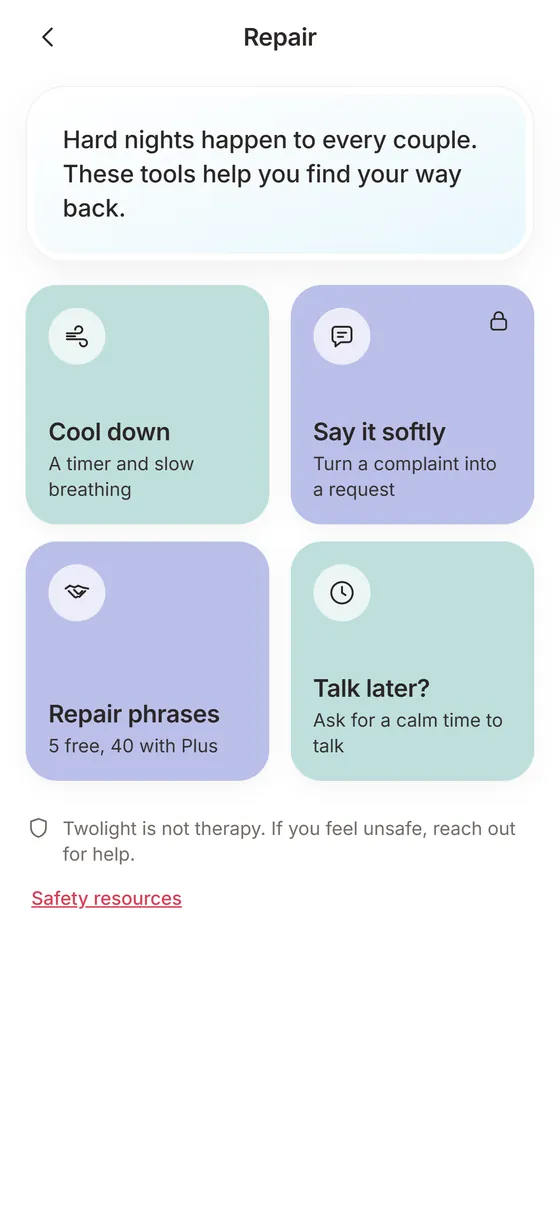 Couples Repair KitCool-down timer, soft start-up, repair phrases and a talk-later message.How to Apologize After a FightA calm, practical way back after an argument.How to Stop Arguing With Your Partner Over Small ThingsA practical routine for fewer fights: pause, soft start-up, one topic, repair.How to Give Your Partner Space Without Feeling DistantAsk three questions, fill the wait kindly and plan the reconnection.