 Twolight
How to give your partner space without feeling distant
Giving space works when it has three parts: you understand what your partner needs, you agree roughly how long, and you both know how you will reconnect. Space with a plan feels like care. Space without one feels like distance. Here are the questions, scripts and habits that help.
Coming soon to iPhone
What does it mean when my partner asks for space?
Most of the time it means they need time alone to recover, think or rest, and it is not a judgment about you. People recharge in different ways. Some want company after a hard day, and others need an hour of quiet before they can talk.
The phrase can also follow a conflict, where it often means I am overwhelmed and need to settle down. That is similar to a pause during an argument. If you are unsure which it is, ask, in a warm voice, without pressing for a full explanation.
What should I ask when they ask for space?
Three short questions turn a vague request into a plan. Ask them calmly and accept what they say:
- How long do you think you need: an hour, tonight, the weekend?
- Is there anything that would help in the meantime, or do you prefer I leave you alone?
- How would you like us to reconnect afterward?
A rough time and a way back matter more than the exact answer.
What should I do while I wait?
Use the time for yourself. Go for a walk, call a friend, cook, clean or start something absorbing. Waiting by the phone rarely helps anyone, and checking in every ten minutes turns space into pressure.
Avoid reading silence as rejection. If your mind starts writing worst-case stories, write them down and look at them later. Remind yourself that your partner asked for time, not an ending, and keep your side of the plan.
- Agree on the rough time.
- Pick one activity that is only for you.
- Send at most one warm message, such as I am here when you want me.
- Keep the plan: if the time passes, check in once in a gentle way.
How do I give space when we live together?
Make space physical. Agree on a room, a walk or an hour when someone is off duty. A closed door or headphones can be a clear signal. Being in the same flat with no signal leads to guessing and tension.
Also agree on the small logistics: who handles dinner, the kids or the pet during the pause. If one of you is stepping away, it helps to say what they can count on. I will take the kids to the park and be back at six.
How do I ask for space myself?
Say it plainly, include a time, and attach a warm word. I need an hour on my own to settle. It is not about you, and I want to be with you after that. A clear sentence protects your partner from filling the silence with fear.
In Twolight, the cool-down timer can do the sentence for you. Choose 10, 20 or 30 minutes, and the Let your partner know button sends: Alex is taking 20 minutes to cool down and will come back to talk. If you only need some alone time, use the Talk later? message to set a calm time to reconnect.
How is space different from avoiding a problem?
Healthy space has an end and a topic you return to. Avoidance has neither. If your partner takes space and the issue never comes back, or if you often use space to dodge a conversation, the problem is likely to return louder.
Research on conflict, summarized in a Wikipedia article, links withdrawing without any return to a pattern called stonewalling. A short break with a promise to return is different, and it is encouraged.
How do we reconnect after space?
Start small. A hug, a cup of tea or a few minutes of sitting together before you talk about anything serious. Thank your partner for the time and for coming back. If there was an issue, start with a soft opening: I feel calmer now. Can we talk about what happened?
Couples sometimes like a short ritual to close the gap. The daily question in Twolight is one option: two minutes of curiosity about something light, such as Which song reminds you of us, and why that one? It brings you back to each other before the heavier topic.
What if we need different amounts of space?
Many couples have one partner who recharges alone and one who recharges together. Neither is wrong. The mismatch becomes a problem when each reads the other's habit as a judgment: you never want to be near me, or you are always crowding me.
Talk about it when you are both calm. Describe your own pattern in plain terms: after work I need about half an hour of quiet, and then I am glad to be with you. Agree on a daily routine that gives the first person their quiet and the second person a dependable time to connect. Predictability calms both sides.
- Name your own pattern without describing your partner's.
- Agree on a daily window of quiet and a daily window of connection.
- Review the arrangement after a month and adjust.
What can I do to feel close while giving space?
Small signals travel well across a closed door. A note, a cup of tea left outside, or a text that says no reply needed make it clear that you are on their side. They cost your partner nothing and keep the thread alive.
For couples who live in different cities, space and closeness take on a different shape. Tools such as a thinking-of-you tap, five a day free in Twolight, or an open-when note sealed for a hard day, show care without asking for an answer. See the long-distance features for how they work.
When is the need for space a sign of a bigger issue?
If one of you needs space constantly, if closeness often feels like pressure, or if you feel more alone together than apart, talk about the pattern when you are both calm. A licensed counselor can help sort out whether it is about stress, differing needs or something else.
Twolight is a communication aid and not therapy. If you feel unsafe, see the Safety resources screen in Settings or call your local emergency number.
The repair kit includes a message that asks for a time to talk, and the guide to the silent treatment explains how a calm break differs from withdrawal.
Frequently asked questions
How long should I give my partner space?
Ask them. A typical range is an hour to a day, depending on the situation. Agree on a rough return time so the wait is not open-ended.
How do I give space without seeming distant?
Say one warm sentence, such as I am here when you want me, then do something for yourself and keep your plan. Warmth plus a clear plan prevents the feeling of distance.
Should I text my partner while they take space?
At most one gentle message. Repeated texts turn space into pressure. Wait until the agreed time for a longer check-in.
Does needing space mean my partner is losing interest?
Not usually. Needing time alone is common and often relates to stress or recharging. If you worry, ask calmly and listen to the answer.
How can Twolight help when someone needs space?
The cool-down timer lets you take 10, 20 or 30 minutes and tell your partner you will return. Talk later? sets a calm time to talk afterward.
Keep exploring
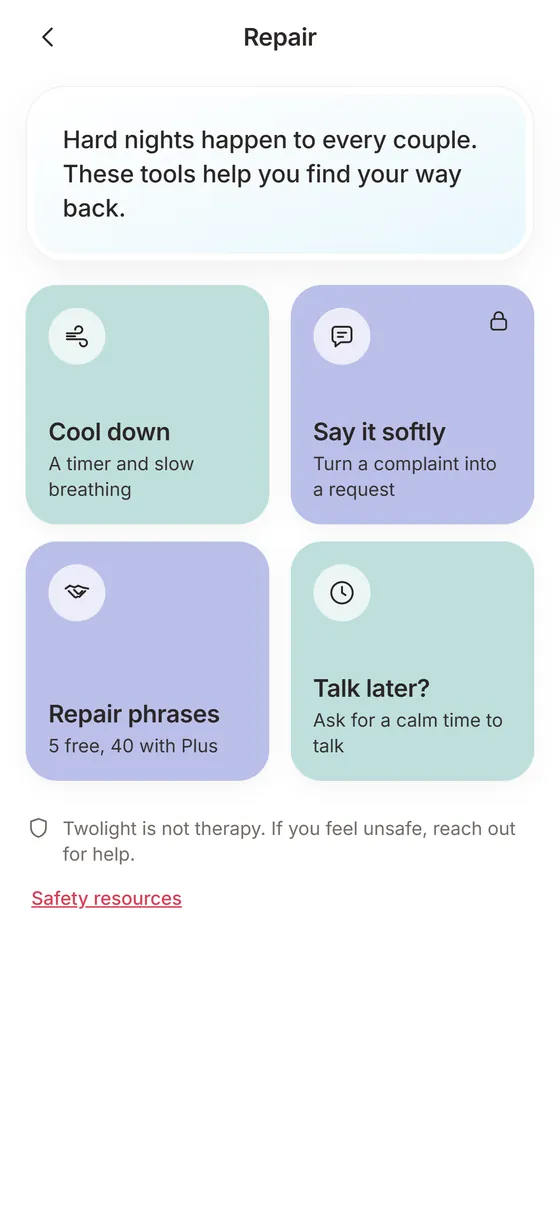 Couples Repair KitCool-down timer, soft start-up, repair phrases and a talk-later message.Silent Treatment in a RelationshipSilent treatment vs a calm break, why it happens and what to say on both sides.How to Start a Hard Conversation With Your PartnerA calm opening, a heads-up and a way to pause: scripts for money, chores and more.
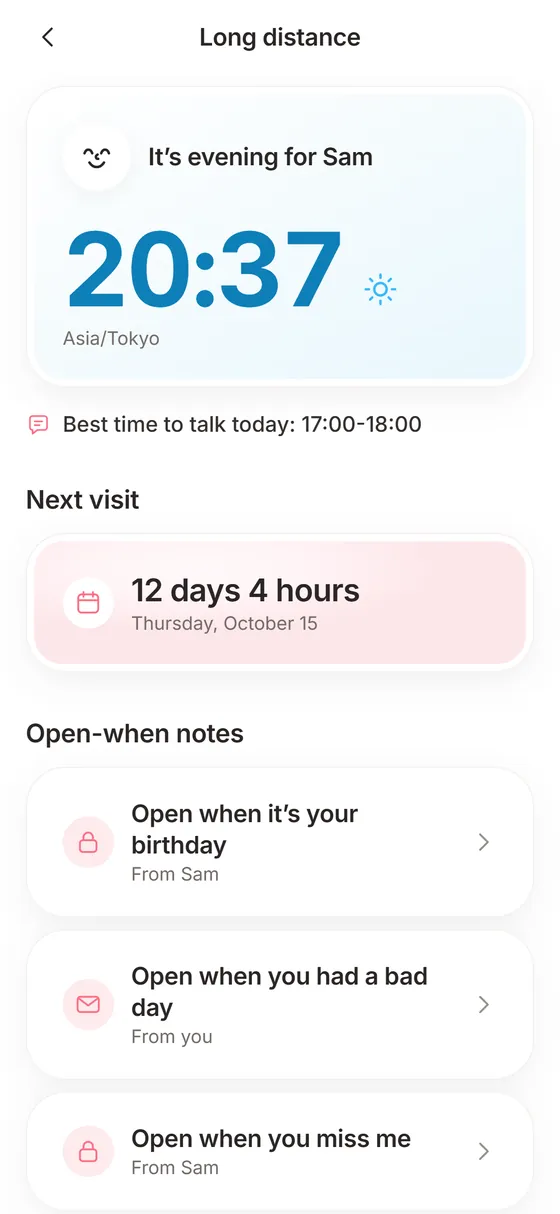 Long Distance Couple ToolsTheir clock, your next visit and notes to open later.How to Reconnect With Your Partner When You Feel DistantName the distance kindly, then a seven-day plan of small daily moments.