 Twolight
How to make time for your partner when life is full
Make time for your partner by setting three small anchors: ten minutes daily, one protected block weekly and one longer outing monthly. Put them on the calendar, guard them from phones and treat missed ones as moved, not canceled. Below are ready-made rituals for every length of window.
Coming soon to iPhone
How do you find time for your partner when you are busy?
Stop waiting for free time and schedule small blocks. Most couples do not have hours of spare evening, but nearly everyone has ten minutes. A routine anchored to something that already happens, such as after the kids are asleep or while the coffee brews, survives busy weeks better than a plan that needs a good mood.
Three anchors are enough for most couples. A daily one (10 minutes), a weekly one (an evening or two hours) and a monthly one (a half day or a proper outing). Write them in the calendar like an appointment with someone you care about, because that is what they are.
| Anchor | How long | Example |
|---|---|---|
| Daily | 10 to 15 minutes | Answer one question, phones away, after the kids sleep |
| Weekly | 2 hours or an evening | A home date, a walk or a meal out |
| Monthly | Half a day | A longer outing or a day trip, with childcare arranged |
What can we do in ten minutes?
Ten minutes is long enough to feel seen if nothing else competes. The key is that both phones are out of reach and you do one thing together:
- Answer a daily question and read both answers aloud.
- Take a short walk around the block.
- Share a hot drink on the sofa and ask What was the best five minutes of your day?
- Play three cards from a question deck.
- Slow dance to one song in the kitchen.
How does the daily question fit a busy day?
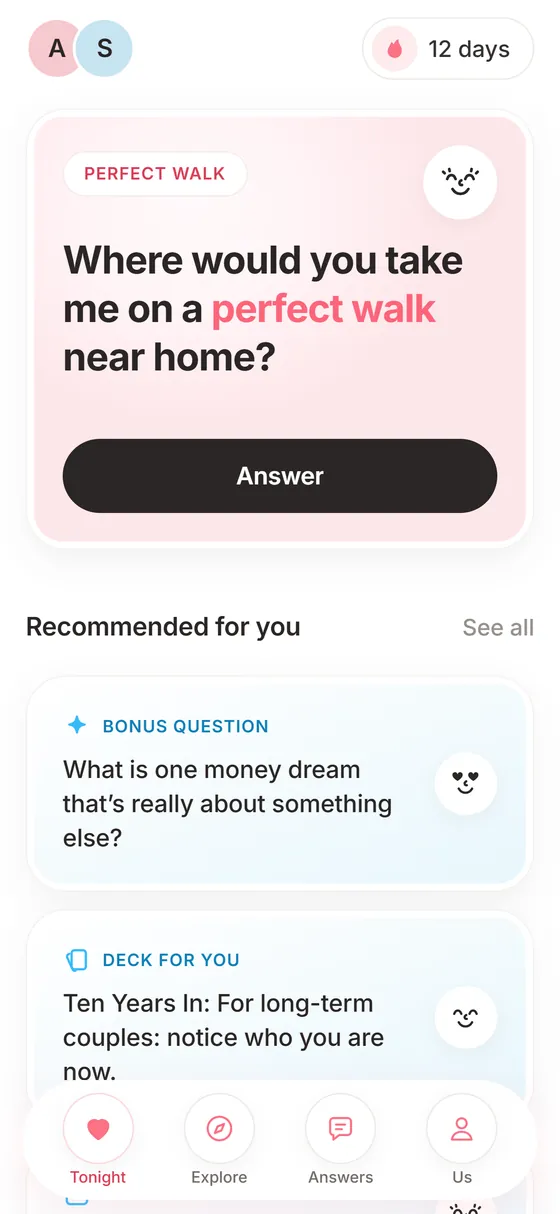
Twolight is designed around this idea: the Tonight tab shows one question, takes two minutes to answer, and keeps both answers hidden until both of you have replied. You can set the reminder to the time you are usually both home, and the reminder is skipped on evenings you have already answered.
If your partner is out or busy, you can still answer and send the link later. Answers are saved on your phone with the line Saved on this phone. See the daily question feature for the full flow.
What can we do in an hour or two?
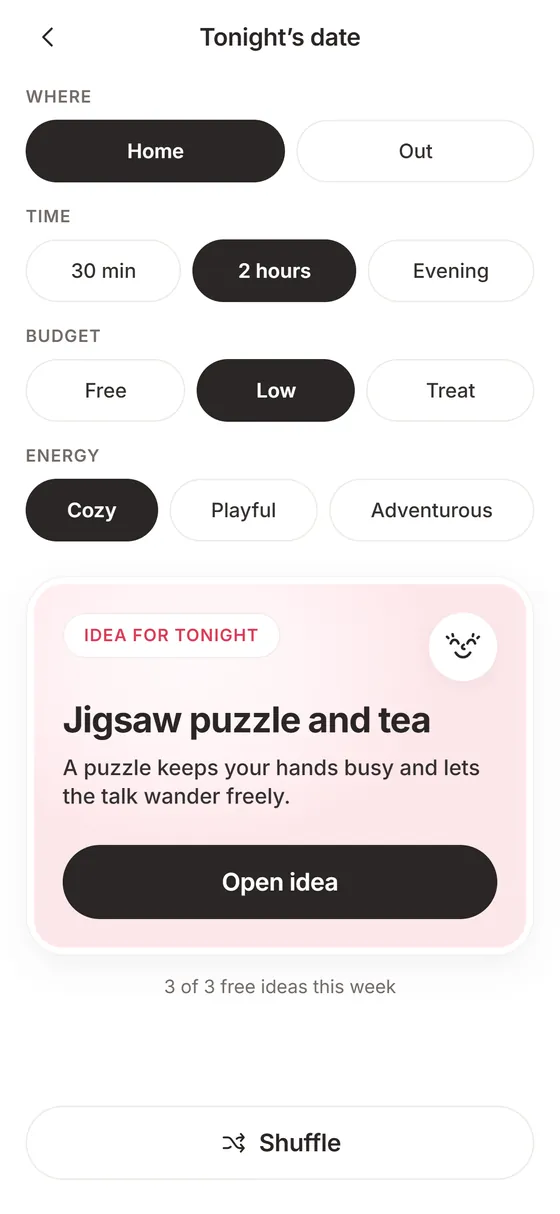
A weekly block of one to two hours gives you room for a real activity. Decide in advance so that the evening is not spent choosing. The date generator in Twolight asks four things (Home or Out, 30 minutes, 2 hours or Evening, Free, Low or Treat, Cozy, Playful or Adventurous) and returns one idea with steps and a question for the middle of the date.
For parents there is a Parents Tonight deck with cards like What date night could we have at home after bedtime? and How could we share the mental load in a way that feels good? Read more in date night ideas at home.
How do we protect the time from phones and chores?
Agree on rules before the time starts. Phones go in another room or in a basket, and the laundry waits. If one of you is on call, agree on what counts as an emergency. Decide who is responsible for the plan each week so the same person does not do all the organizing.
Be kind about misses. Life will interrupt. When it does, move the slot instead of dropping it: we skipped Tuesday, so let us do Thursday. This keeps the habit alive without guilt.
- Choose the day and time for each anchor.
- Put them in both calendars with a reminder.
- Agree on phone rules.
- Decide who plans the weekly block.
- If you miss one, name the replacement time on the spot.
How do I ask my partner for more quality time?
Make a request and not a complaint, and offer a specific plan. We have both been swamped. Could we try ten minutes after the kids sleep each night this week, and see how it feels? A small experiment is easier to accept than a general demand for more.
If it is hard to say, use a sentence builder. Twolight's Say it softly offers I feel, when, I need, for example I feel disconnected when our evenings are spent on separate screens. I need 15 minutes with you after dinner. Say it in person, copy it or send it.
What if we have little help with childcare?
Use the child's own schedule. Nap time, a screen show or the first hour after bedtime can all hold a short ritual. Trade babysitting with another couple, ask a relative for one block a month, or alternate: one weekend morning each, so that both of you get alone time and then time together.
Lower the cost of the date as well. A picnic on the living-room floor, a movie from your own shelf and a three-course meal made from the fridge can feel like an evening out. Twolight's idea bank includes both home and out options, and 27 of the home ideas are free.
Why is a monthly outing worth the effort?
A longer outing gives you something new to share. Summaries of the self-expansion model link shared new activities with better relationship quality and less boredom, which is a good reason to try a trail, a museum or a neighborhood you have not visited before.
Keep the plan modest. A half day with a clear start and finish beats an ambitious weekend that needs three weeks of preparation. Choose an idea from the generator with Out, Evening and Adventurous, and agree who is responsible for childcare early.
What do we do when one of us travels or works shifts?
Use whatever overlap you have. A shared question can be answered at different hours, because the answers wait until both of you have replied. If you are in different time zones, Twolight's dual clock shows your partner's local time with a state such as probably asleep or about to wake up, and suggests the best window to talk today.
For shift workers, the anchors can move: a daily ritual at 7 a.m. for one week and 9 p.m. for the next. What matters is that the ritual has a name and a place in the calendar, so it does not rely on leftover energy.
How do we keep it up over months?
Track it lightly. A streak counter helps some people, and Twolight counts any ritual toward the streak: a question, a couch round or a Guess Me. Missed days are covered by free streak freezes, two a month free and four with Plus. If counters stress you, skip them and review once a month instead.
At the end of each month, ask each other what worked and what to change: Which moment this month do you want more of? Adjust the anchors to the season you are in. Habits that fit your real life are the ones that last.
Frequently asked questions
How much quality time should couples spend together?
There is no universal number. Many couples find that a daily check-in of 10 to 15 minutes and one longer block a week keeps them connected. Pick amounts you can keep.
How do you make time for your partner with a baby?
Use the baby's sleep. Five to ten minutes after bedtime, phones away, one question each. Lower your expectations for dates and raise your consistency.
What if my partner is always busy?
Propose a tiny, specific ritual and attach it to something that already happens, like a morning coffee. Ask what time would work for them.
Is a short daily routine enough?
For many couples it helps a lot, especially if it includes real attention. Add a weekly longer block when you can.
Does Twolight work if we live in different time zones?
Yes. The daily question travels by link, and the dual clock shows your partner's local time and a good window to talk.
Keep exploring
 Daily Question for CouplesOne question a night; answers reveal when both are in.
 Date Night Ideas GeneratorPick where, time, budget and energy; get one idea to try tonight.Date Night Ideas at Home by Time, Budget and EnergyAt-home date ideas matched to your time, budget and energy.Daily Questions for CouplesA small, regular question habit that survives busy weeks.How to Reconnect With Your Partner When You Feel DistantName the distance kindly, then a seven-day plan of small daily moments.