 Twolight
Long distance relationship tips for time zones, calls and visits
Long distance relationships work when both people agree on a rhythm of contact, plan the next visit, and talk openly about the plan to close the distance. Handle time zones with a shared clock, keep calls short and regular, and share ordinary details. Tips for each follow.
Coming soon to iPhone
What are the most important long distance relationship tips?
Agree on a rhythm, share the ordinary, plan the next visit and keep an eye on the end goal. A long-distance relationship lacks the daily overlap that most couples take for granted, so the habits that replace it have to be deliberate.
Treat these tips as a menu. Some couples like daily calls, others prefer a few meaningful ones a week. What matters is that both of you know what to expect and say when it stops working.
- Agree on a rhythm of contact that fits both schedules.
- Share ordinary details, not only highlights.
- Always know the date of the next visit.
- Talk about trust before you need to.
- Use small signals between calls.
- Agree on a plan or a timeline for closing the distance.
How do I handle time zones?
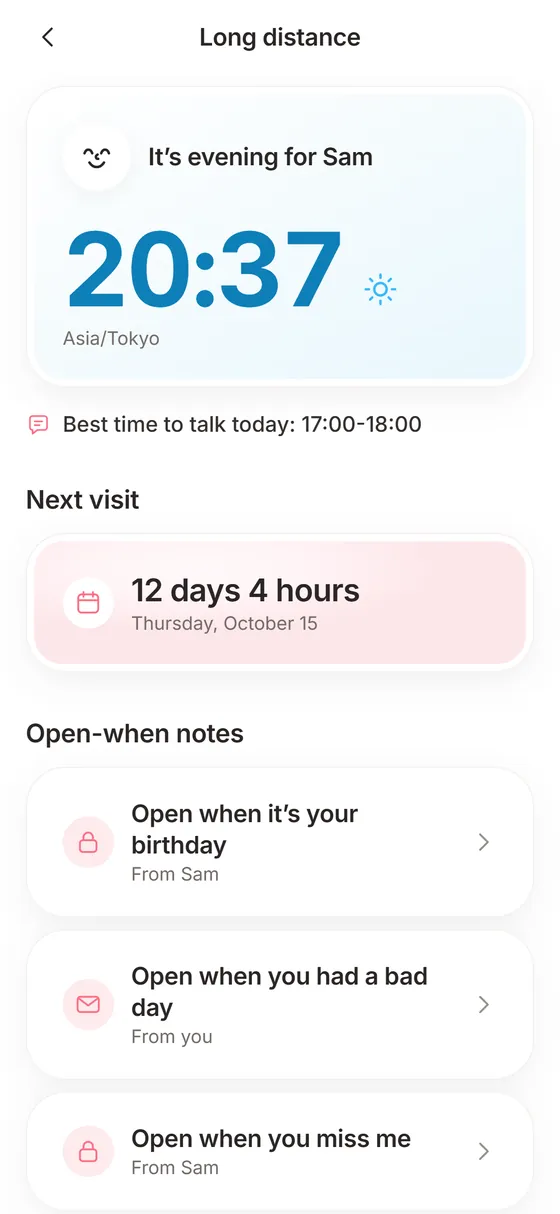
Make the gap visible. Twolight's long-distance screen shows your partner's local time with a state such as probably asleep or about to wake up, and a best window to talk today. When your waking hours barely overlap, it says so and suggests a voice note instead.
Share the cost of the gap. If one person always stays up late, resentment builds. Alternate, or choose a fixed call that is inconvenient for both equally. Remember that clocks change on different dates in different countries, so the difference can shift for a few weeks each year (Wikipedia lists the rules). Check the date before you set a recurring call.
How often should we talk?
There is no ideal number. A useful guide is the smallest rhythm that keeps you both feeling connected without turning contact into an obligation. Many couples use short daily touchpoints, such as a message or a voice note, and one longer call each week.
Quality matters more than quantity. Ten minutes of undivided attention can do more than two hours of a call where one of you is half-watching a screen. A daily question gives the short contacts a topic: you answer on your own time, and when both answers are in, they appear together. See daily questions for couples.
How can we plan visits well?
Always know the date of the next one. A visit on the calendar changes how the weeks feel. In Twolight you can set the date and watch a countdown in days and hours, which keeps the wait visible and gives you something to look forward to.
Lower the pressure on the visits themselves. After weeks apart, expectations can run high, and small frictions feel bigger. Leave room for ordinary time together, such as cooking and errands, and avoid scheduling every hour. Talk about the goodbye in advance, too: what would make the day after a visit a little softer?
- Set the next date before you say goodbye.
- Decide who travels and share the cost fairly.
- Plan one special thing and leave the rest open.
- Agree how you will say goodbye.
- Plan one activity for the day after, such as a call or a note.
How do I talk about trust and jealousy?
Raise it early and calmly, before something triggers it. Describe your feelings without accusing: I sometimes feel anxious when I do not hear from you for a day. What would help us both? Agree on small commitments, such as letting each other know when you will be out of reach, and keep them.
Trust is built with reliability. Do what you said you would do, text when you said you would, and share good news and bad. If one of you struggles with persistent worry, a licensed counselor can help, and no tool replaces that support.
What small signals help between calls?
Small gestures remind your partner that you are thinking of them. A photo of something that made you laugh, a voice note on your commute or a one-line message in the morning all count. Twolight offers a thinking-of-you tap: five a day free and unlimited with Plus. Your partner receives a short notice and can send one back.
Bigger gestures can be scheduled. Seal an open-when note for a hard day or send a small package. See open when letters for ideas. Keep a record of the good days, too. A shared note with moments from the visit makes the next gap easier.
How do we plan to close the distance?
An open-ended long distance relationship is much harder than one with a direction. Talk about when and how you want to live in the same place, who might move, and what each of you needs to make the decision. You do not need all the answers, but you do need to talk.
Set a check-in every few months: How are we doing? Is the plan still the right one? What has changed? If one of you is more ready than the other, say so kindly. The Far Apart deck includes cards for this, such as What do you picture when you imagine us in the same city? Read more in long-distance questions.
How do we share daily life when we cannot be together?
Share the small things on purpose. A photo of your lunch, the view from your window, a voice note about a funny person on the train. These details are what a shared home normally supplies for free, and they keep your partner's picture of your life up to date.
Try a daily exchange with one rule: nothing needs to be impressive. A weather report, a song of the day or one sentence about the best moment of the day is enough. Twolight's Far Apart deck has cards that fit, such as What funny thing happened to you today that I missed? and Which place in your city would you show me first?
What if the distance is getting too hard?
Say so early and kindly, before resentment builds. Describe what is hard, not who is to blame, and ask what would help. Sometimes a change in rhythm, a firmer plan or a shorter gap between visits is enough. Sometimes the honest conversation is about whether the plan still works for both of you.
If the strain is heavy, talking to a counselor or a trusted friend can help. Twolight is a conversation aid and not therapy, and the Safety resources screen in Settings explains how to find help if you ever feel unsafe.
Frequently asked questions
How do you make a long distance relationship work?
Agree on a rhythm of contact, share ordinary details, always plan the next visit, talk about trust and agree on a direction for closing the distance.
How often should long distance couples talk?
A short daily contact and one longer call a week suits many couples. Choose a rhythm that keeps you both connected without feeling obligatory.
How do you handle time zone differences in a relationship?
Use a clock that shows your partner's local time and best window to talk, alternate who adapts, and use asynchronous contact like voice notes when schedules clash.
What is the biggest challenge in long distance relationships?
Many couples say uncertainty about the future and the lack of everyday contact. A clear plan and regular small signals help with both.
Does Twolight work for long distance couples?
Yes. It has a dual clock, a visit countdown, open-when notes (Plus), thinking-of-you taps and a daily question that travels by link.
Keep exploring
 Long Distance Couple ToolsTheir clock, your next visit and notes to open later.Long Distance Relationship Questions40 questions for daily life, missing, visits and the future, plus tips.Long Distance Date Ideas25 date ideas for video, voice, text and mail, plus tips for time zones.Open When Letters30 open-when occasions, writing prompts and tips for paper and digital notes.